
What Are ChatGPT Ads? Everything We Know So Far
ChatGPT ads have moved from speculation to reality. As of February 9, 2026, OpenAI began testing ads in ChatGPT for logged-in adult users in the U.S. on the Free and Go plans. According to OpenAI, those ads are separate from the answer itself, clearly labeled, and do not influence the responses ChatGPT gives. OpenAI also says that conversations are kept private from advertisers and that user data is not sold to them.
That matters for marketers because ChatGPT ads are not just another social placement or another search ad unit. They sit inside a behavior shift that is already changing how people discover products, compare options, and narrow decisions. More people are using AI tools to ask complex questions that would have previously turned into a series of Google searches. If ChatGPT becomes part of the buying journey, then visibility inside AI systems will become a serious strategic channel, not a novelty.
For brands, this is the real takeaway. ChatGPT ads are important, but they are only one part of a larger change in digital discovery. The businesses that win will not treat this as a gimmick. They will treat it as a signal that SEO, AI SEO, GEO, content clarity, paid media, and website experience now need to work together.
ChatGPT Ads Are Real, But Still Early
OpenAI has been careful about how it frames this rollout. The company first outlined its advertising approach in January 2026, saying it planned to test ads for Free and Go users in the U.S. and that paid tiers would remain ad-free. It then formally announced the test on February 9, 2026.
So when people ask what ChatGPT ads are, the best answer right now is this: they are a new sponsored placement being tested inside ChatGPT for a limited user segment, not a fully mature ad ecosystem with years of best practices behind it.
That distinction matters. Early-stage platforms often create a lot of noise. Some brands assume they need to jump in immediately. Others assume the channel is too new to matter. The smarter view is somewhere in the middle. This is early, but it is early in a space that could shape how search and paid discovery work over the next few years.

Who Sees ChatGPT Ads Right Now
Based on OpenAI’s official statements, the current test applies to logged-in adult users in the U.S. on the Free and Go plans. Plus, Pro, Business, Enterprise, and Education plans do not have ads. OpenAI also says ad controls are currently available for Free and Go users in the U.S.
Users can:
- Turn off ad personalization
- Dismiss ads and give feedback
- See why a specific ad was shown
- Clear data used for ads
That is a meaningful point for marketers. This is not a black box where users have no agency. OpenAI is clearly trying to position ChatGPT ads as controlled, transparent, and separated from core answers.
Where ChatGPT Ads Appear
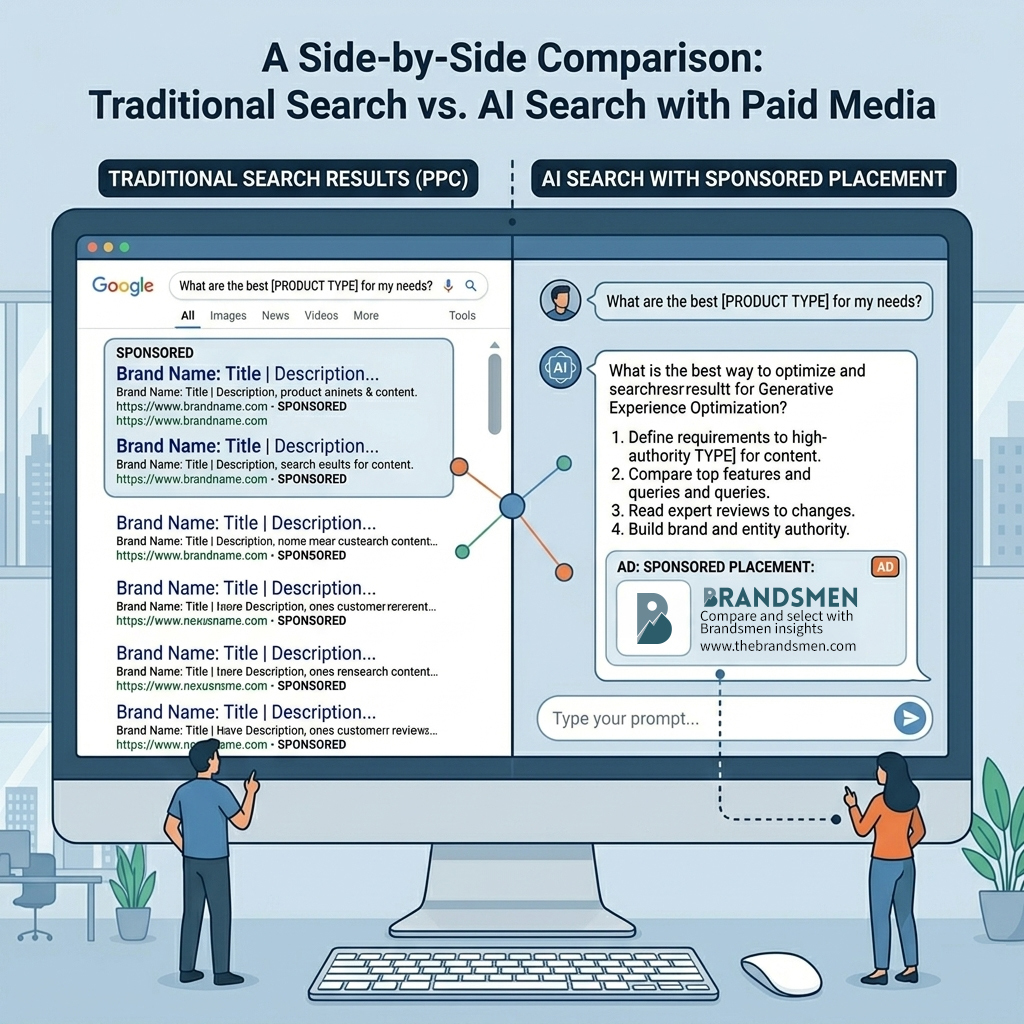
OpenAI said it plans to test ads at the bottom of answers when there is a relevant sponsored product or service based on the current conversation. It also said ads will be clearly labeled and separated from the organic results.
That creates a very different dynamic from traditional paid search.
On Google, the user expects a results page with paid and organic listings mixed into a familiar layout. In ChatGPT, the user is often in the middle of a conversation, asking for synthesis, recommendations, or decision support. That means the ad experience has to feel less interruptive and more context-aware.
From a strategy perspective, that likely makes message quality more important than brute force targeting. If someone is using ChatGPT to solve a specific problem, weak creativity will stand out fast. The same goes for weak landing pages. A sponsored placement inside an AI conversation may earn attention, but it will not rescue a brand with unclear positioning or a bad user experience.
What ChatGPT Ads Are Not
This is where a lot of confusion is likely to happen.
ChatGPT ads are not the same thing as shopping research. OpenAI’s help documentation explicitly says ads are separate from shopping research. Shopping research is a feature that helps users compare products and generate buyer’s guides using current retailer information.
They are also not the same thing as ChatGPT’s broader commerce features, such as Instant Checkout and merchant integrations. Those tools relate to product discovery and purchase flow, while ChatGPT ads are sponsored placements inside the chat experience.
For marketers, that distinction is important because it points to three different layers of visibility:
- Organic visibility in AI answers
- Sponsored visibility through ChatGPT ads
- Commerce visibility through product and merchant integrations
A brand that focuses only on ads will miss the broader opportunity.
Why OpenAI Is Introducing Ads
OpenAI’s explanation is straightforward. It says ChatGPT is used by hundreds of millions of people and that keeping Free and Go tiers fast and reliable requires ongoing infrastructure investment. Ads, in its words, help fund broader access to AI and support higher-quality free and low-cost options.
That is a familiar platform logic. Free access grows reach. Advertising helps subsidize that reach. But OpenAI has also emphasized that trust is the guardrail. Its public principles say answers should remain independent, ads should be clearly labeled, conversations should remain private from advertisers, and there should always be a way to avoid ads through a paid tier.
Whether users accept that model long-term will depend on execution. If the ad experience remains relevant and clearly separated, it may become the norm. If it feels invasive or manipulative, users will push back quickly.
Sensitive Categories And Limits Matter
OpenAI has also said that during the test, it will not show ads in accounts where the user tells OpenAI or OpenAI predicts the user is under 18. It also says ads are not eligible to appear near sensitive or regulated topics such as health, mental health, or politics.
That is especially relevant for brands in regulated industries. It suggests ChatGPT ads may not behave like an open marketplace where every category can compete everywhere. Restrictions, adjacency standards, and trust policies may shape inventory in a major way.
For marketers, that means channel fit will matter. Not every business that performs well in Google Ads or paid social will necessarily be a fit for ChatGPT ads.

What Brands Should Do Now
The wrong move is to wait for a perfect playbook. The right move is to prepare for a new environment where people discover brands through AI conversations.
Here is the practical checklist:
- Tighten your positioning so your offer is easy to understand in one pass
- Improve your website copy so landing pages answer real buyer questions
- Build content that is structured clearly enough for both humans and AI systems
- Strengthen traditional SEO because AI visibility still depends on a strong content ecosystem
- Audit paid traffic journeys so your conversion path is simple and measurable
- Separate experiments from hype and track what actually moves the pipeline
This is where The Brandsmen’s approach fits naturally. The company was founded in Denver in 2014 with a philosophy built around honest, purposeful, authentic work and long-term relationships, not smoke-and-mirrors marketing. Its service mix spans SEO, paid ads, branding, website design, and AI SEO, which is exactly the kind of integrated setup brands need as AI-driven discovery becomes more commercial.
That matters because ChatGPT ads should not live in a silo. If your brand voice is weak, branding work matters. If your site does not convert, web design matters. If your content is thin, SEO and AI SEO matter. If you want to test sponsored visibility, PPC strategy matters. This is not a one-channel problem.
The Bigger Opportunity Behind ChatGPT Ads
The real story is not just that ChatGPT ads exist. The real story is that AI assistants are becoming part of the path to purchase.
The Brandsmen’s own AI SEO positioning reflects this shift by focusing on how brands show up in AI tools like ChatGPT while still supporting traditional search performance. Its GEO and AEO content also frames the shift correctly: the fundamentals of search have not disappeared, but the interfaces and discovery paths are changing.
That is the lens smart brands should use.
Do not ask only, “How do we buy ChatGPT ads?”
Also ask:
- Are we the kind of source AI systems would want to reference?
- Is our site ready when AI-driven traffic lands?
- Is our offer clear enough to convert in a lower-click environment?
- Do we have reporting in place to separate curiosity traffic from qualified demand?
Those are better questions because they lead to a stronger digital strategy, whether you run ChatGPT ads tomorrow or six months from now.
Final Thoughts
ChatGPT ads are here in test form, and the current facts are clear. OpenAI is testing them for logged-in adult users in the U.S. on Free and Go plans. Ads appear separately from answers, are clearly labeled, do not influence responses, and include user controls for personalization and feedback. They are also distinct from the shopping research and commerce features already built into ChatGPT.
For brands, this is less about chasing a headline and more about preparing for where digital discovery is going. Search is getting more conversational. AI is getting closer to commercial intent. And the brands that invest now in strong content, clear positioning, a measurable paid strategy, and AI-ready visibility will be in a better position than those waiting for the channel to feel comfortable.
About the Author