
AEO vs SEO: What’s the Difference in 2026?
AEO vs SEO: What’s the Difference in 2026?
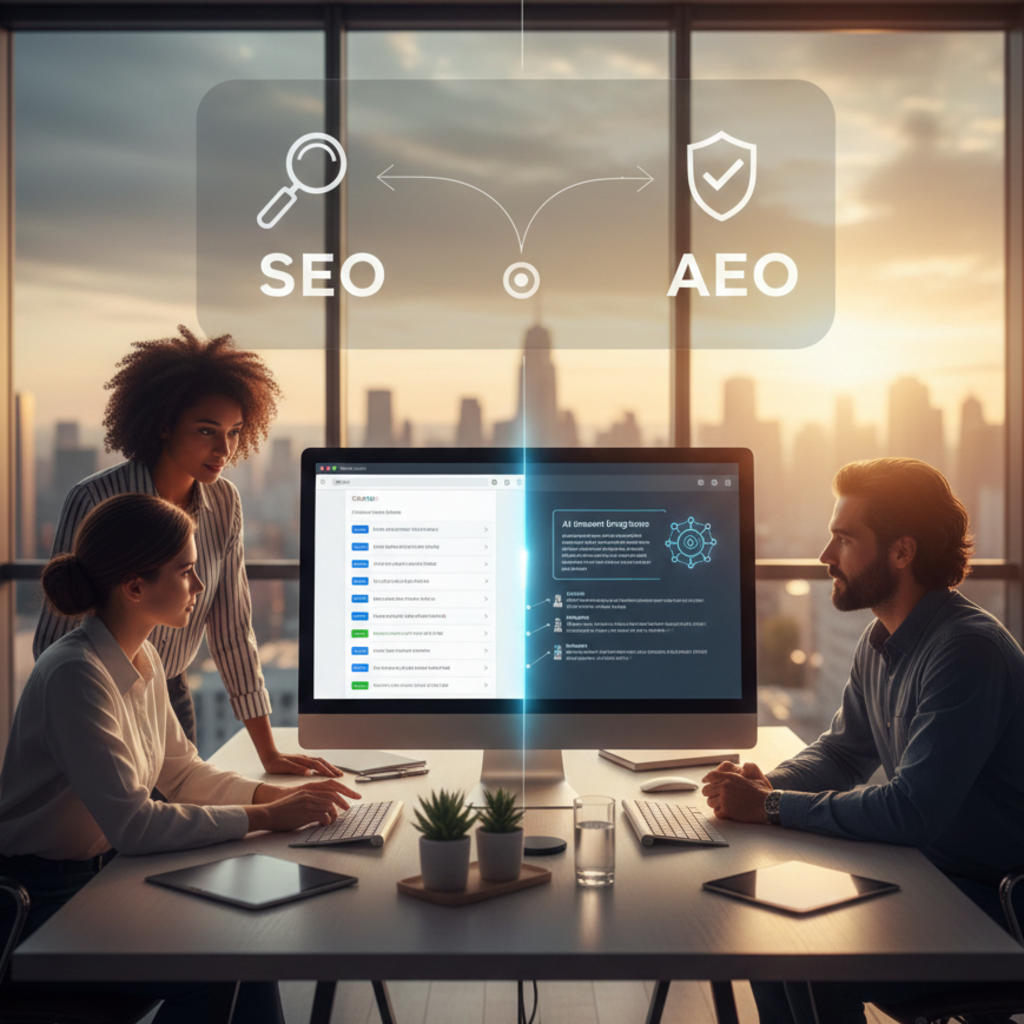
If you feel like search changed overnight, you are not imagining it. Traditional results still matter, but more queries now get answered directly on the results page through AI summaries, featured snippets, and chat-style experiences. That shift is the heart of AEO vs SEO in 2026.
SEO helps you get discovered and earn visits. AEO helps you get selected as the answer, even when the user never clicks.
Below is a plain-English breakdown of what changed, what stayed the same, and how to update your strategy without throwing out what already works.
What SEO Still Means in 2026
Search Engine Optimization is still the discipline of helping search engines understand your site and rank it for relevant queries. SEO is built on fundamentals that have not gone away:
- Crawlability and indexability (your content can be found and read)
- Helpful, relevant content aligned to intent
- Strong on-page structure (titles, headers, internal linking)
- Authority signals (links, reputation, brand mentions, expertise)
- Great page experience (fast, usable, mobile-friendly)
In other words, SEO is still about discoverability and rankings in traditional search systems. Even when AI is involved, it usually depends on the same underlying content ecosystem.

What AEO Means (and Why It Exists)
Answer Engine Optimization focuses on getting your content chosen for direct answers, like:
- AI summaries (Google AI Overviews and similar experiences)
- Featured snippets
- Voice results
- Chat-style answers inside search and assistant tools
Google describes AI features like AI Overviews as experiences that can surface content in new ways, and the baseline guidance is still to make content helpful, accessible, and clearly structured for users.
So in AEO vs SEO, AEO is not “instead of SEO.” It is SEO plus answer readiness.
AEO vs SEO: The Practical Difference
Here is the simplest way to think about AEO vs SEO:
- SEO goal: rank well and win the click.
- AEO goal: get extracted, quoted, cited, or used to form the answer.
That changes how you write and structure content. AEO pushes you to:
- Map questions to answers (one page can target multiple tightly-related questions).
- Put the answer early (then expand with context).
- Make your content easy to reuse (clean definitions, steps, and comparisons).
- Clarify entities (who, what, where, and how it relates).
- Strengthen trust signals (proof, sourcing, expertise, and consistency).
Google’s featured snippet guidance reinforces the idea that formatting and clarity influence what gets surfaced.
Why “Zero-Click” Matters More Now
A big reason AEO is gaining traction is that “getting the click” is no longer the only win. Independent research shows users click less when AI-style summaries appear in results. For example, Pew Research found that when an AI summary was present, users clicked on traditional results less often than when no AI summary appeared. A separate consumer survey research from Bain also reports that many people now rely on zero-click results for a meaningful share of their searches, which can reduce organic traffic even when your visibility is strong.
This is also why the phrase “future of SEO” is often misunderstood. The future is not “SEO is dead.” It is SEO plus a strategy for visibility when the visit does not happen.
Where SEO and AEO Overlap (A Lot)
Most of what helps AEO also helps SEO:
- Clear H1 and H2 structure
- Scannable sections
- Strong internal linking
- Topical coverage that proves you understand the subject
- Clean technical foundation
- Real-world credibility
That is why AEO vs SEO is not a fork in the road. It is a layering of priorities.
What AEO Adds that Many SEO Programs Are Missing
Here are the AEO-specific upgrades we are implementing most often in 2026:
1) “Answer-first” formatting
Lead with a direct answer in the first 2–3 sentences of a section, then explain. This is especially important for informational queries that trigger AI summaries.
2) Query-to-answer mapping
Instead of writing one broad post and hoping it ranks, build a page around a tight cluster of related questions, each answered clearly under its own header.
3) Entity clarity
AI systems rely heavily on entity understanding. Be explicit:
- What is the thing?
- Who is it for?
- What category does it belong to?
- What is it not?
4) Citation-ready trust signals
AI answers often lean on sources that appear reliable and easy to verify. You can support that with:
- Named authors and bios
- Clear “last updated” dates
- References to primary documentation (when appropriate)
- Consistent brand identity across the site
Google also provides guidance around how content can appear in AI features and how site owners should approach inclusion.
How to Update Your Content Strategy for SEO vs AI Search
If your team is worried about SEO vs AI search, focus on these five moves.
- Keep your SEO foundation strong
Fix technical issues, improve internal linking, and keep building content that matches intent. - Rewrite key pages for answers
Start with your most important informational pages: define terms, add step-by-step sections, include short summaries, and tighten headers. - Build supporting clusters (not random blogs)
AEO improves when you demonstrate topical depth across a group of related pages, not just one “hero” post. - Measure beyond traffic
Track:- Brand search growth
- Conversions influenced by organic visibility
- “Assisted” conversions from users who discovered you through search, then returned later
- Visibility in snippets and AI features (when available in your tools)
- Create content that AI search engines can reuse responsibly
Whether the interface is Google, Bing, or another assistant, the pattern is similar: content that is well-structured and easy to extract performs better in generative experiences. Bing’s generative search rollout also emphasizes that these experiences show up most often on informational and complex queries.

Quick Checklist: Win AEO Without Hurting SEO
Use this on your next article or landing page:
- Include the primary question in an H2
- Answer it directly in 40–60 words
- Add a short list of steps, bullets, or key points
- Support with examples, definitions, and “why it matters.”
- Use consistent terminology for the same entity
- Add internal links to related supporting pages
- Make author and brand credibility easy to find
This is the practical core of AEO vs SEO. Keep ranking, but also write in a way that makes your content the best “source material” for answers.
How The Brandsmen Can Help
The Brandsmen is a Denver digital marketing agency founded in 2014 with a straightforward philosophy: do work you would be proud to do for a best friend’s business. That means clear strategy, transparent execution, and long-term results built on trust.
If you want help modernizing your approach to AEO vs SEO, we can audit your existing content, identify the pages most likely to earn AI citations and snippet placements, and build a content roadmap that supports both rankings and answer visibility.
About the Author