What Is an AI Visibility Score, and Does It Matter?
Our co-founder explains how these scores get built, what they can and can’t tell you, and what to track instead.
In conversation with

Adam Scheid
Co-Founder & COO @ The Brandsmen
Adam co-founded The Brandsmen and runs the technical side of our work, from SEO and PPC to conversion and data systems, with every project judged by what it does for your bottom line.
Interview by Alex Vere Nicoll • Read more from this author →
In this article
An AI visibility score is a number that estimates how often your brand shows up in answers from tools like ChatGPT, Gemini, Perplexity and Google’s AI features. It can show movement, which is useful. Alone, it’s a vanity metric: it can’t tell you whether anyone called, filled out a form or bought.
If an agency put one of these scores in your last report and you weren’t sure what to make of it, you’re not alone.
Key Takeaways
- The score counts how often AI tools mention you across a set of prompts somebody chose.
- There’s no universal formula, so two tools can hand you two different numbers.
- It’s fine for showing movement. It’s a poor way to judge whether marketing is working.
- Look at calls, form fills, purchases and cost per acquisition first.
Adam Scheid, our co-founder and COO, has this exact metric sitting in our keyword tracking tool. He sat down with Alex Vere Nicoll to talk through what it’s good for and where it stops being useful.
What Is an AI Visibility Score?
An AI visibility score is one number that sums up how often AI tools bring up your brand when people ask about your category. Some tools also grade how favorable the mention was. You’ll usually see a percentage or a score out of 100. Whatever happens after the answer isn’t in it.
Adam doesn’t dress it up. “You have certain keywords and it automates and checks how often you show up for those results.” That’s the whole trick.
He does call visibility “one of the more important metrics,” and here’s why AI search visibility gets so much attention: “click-through rates don’t happen as much in AI.” People get what they need on the platform and never reach your site. Pew found the same pattern on Google:
8% vs 15%
of visits clicked a regular result with an AI summary on the page vs without one
So yes, a mention counts. We just wouldn’t build a report around it.
How AI Visibility Scores Get Calculated
Somebody writes a list of prompts, usually the vendor or your agency. A tool fires them at ChatGPT and the others every so often, notes if your brand came up, and spits out one number. Some add citations, sentiment or share of mentions. Each picks its own prompts and weights, so there’s no standard score.
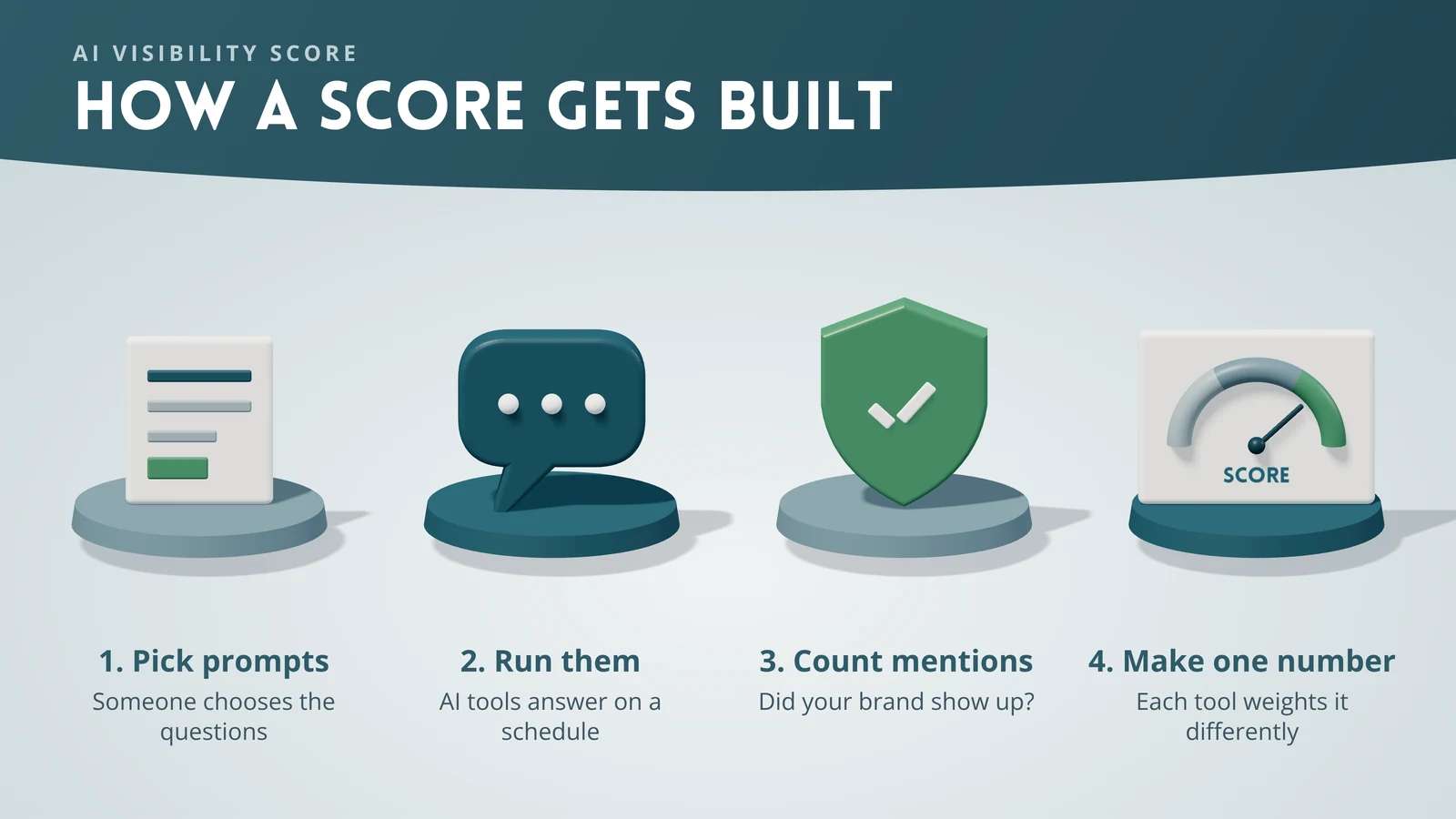
The math is narrower than it looks, too. Get named in 30 of 100 tracked answers and you have 30% visibility in that sample. It doesn’t mean 30% of your customers saw you. The researchers who coined GEO had to build their own measures just to test it. Nobody has settled this yet.
If an agency sends you one of these, ask who wrote the prompts. Soft questions flatter almost anybody. Ask if they ran it on one AI tool or five, and what’s in the number this month that wasn’t there last month.
Why a Visibility Score Alone Is a Vanity Metric
On its own, a visibility score is a vanity metric. It tells you that you got seen, not that anyone chose you. Adam still keeps it around “to kind of show movement” and to show you’re “actually in the algorithms.”
Just don’t make it the goal, because it can climb all quarter while your phone stays quiet.
“It’s another vanity metric. You don’t really want to get bogged down in those.”Adam Scheid, Co-Founder & COO
This pitch is older than AI. “There’s so many agencies out there, right? That just push you on vanity metrics,” Adam says.
The line goes something like “we can get you number one first page, Google for your keyword,” with 10 calls a day thrown in. “And really, it’s just they pick a random keyword.” You rank, sure, for something nobody searches before buying.
AI scores work the same way. Pick easy prompts and the number goes up. And with so many answers ending in a zero-click search, you can post a great score next to flat revenue for months.
What to Measure Instead
Start with what pays for the marketing: calls, form fills, purchases and your cost per acquisition. Visibility comes after, as a clue to why those numbers moved. “You always want to be worried about what your bottom line is, what your cost per acquisition is,” Adam says. That’s the order we use.
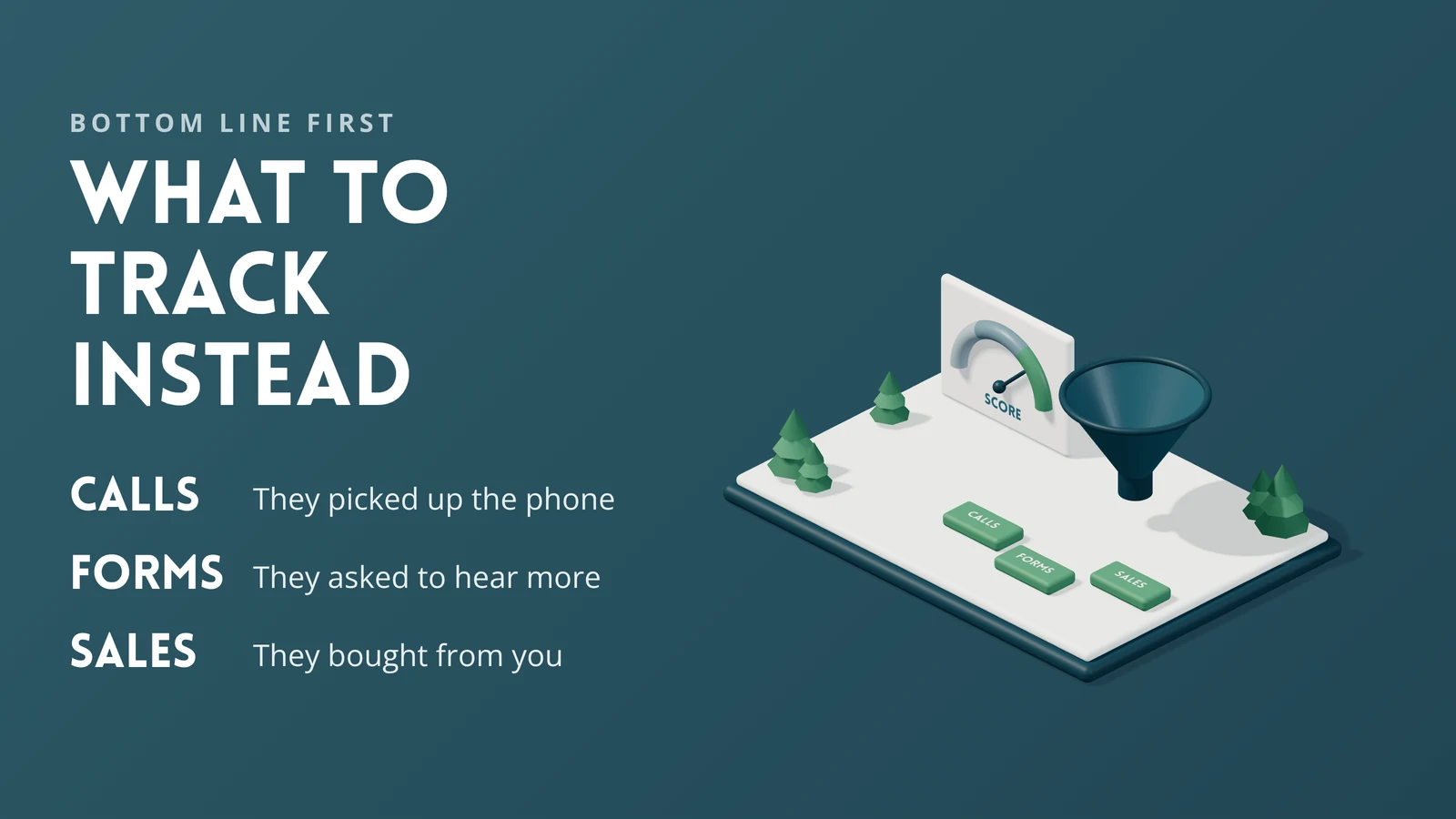
So how do you measure AI visibility? Next to your results, never instead of them. Here’s what each number can and can’t tell you:
| What it tells you | What it can’t tell you | |
|---|---|---|
| AI visibility score | AI tools mention you on tracked prompts | Whether anyone acted on it |
| Rankings | Where a page sits for a keyword | Whether that keyword has buyers |
| Traffic | How many people showed up | Whether they were the right people |
| Calls, forms, purchases | Who raised their hand | Which touchpoint started it, without tracking |
None of this takes fancy software. Your calls, forms and purchases can all be set up as key events in Google Analytics, which is what that feature is for.
Then check intent. Adam’s question is “is that for high-intent keywords?” Being first for something with no buyer behind it gets you a nice screenshot.
“We really want to make sure that what we’re doing for you is going to turn into calls and form fills and product purchases.”Adam Scheid, Co-Founder & COO
Not sure what your last report really told you? Our AI SEO services start by showing you where you rank on Google and where AI tools already cite you.
What Clients Are Asking For Now
Two things, and neither came up much a few years ago. Clients want to show up in AI results, and they want AI to take work off their plate. “Everyone and their mom is using AI now,” Adam says, so the first question he hears is simple: how do I get my business in there?
Fair question. Most of the answer is work you may already be doing. GEO vs SEO isn’t an either-or, and most of optimizing for ChatGPT comes down to clear answers on pages Google already trusts.
The second ask is systems. Owners have seen what AI can automate and they want it everywhere, from marketing to admin. Nothing wrong with that, until a shortcut gets mistaken for a strategy.
The AI Mistake Agencies Keep Making
Agencies keep treating AI as a replacement for people. “It’s supposed to be a tool for humans and not replace humans,” Adam says.
He has built these processes himself, and once you get under the hood, he says it’s “incredible what AI actually messes up.” Those errors compound, and the output still “looks great on paper.”
It also has no real opinion to offer. “AI isn’t using products. AI isn’t using services.” It never bought from you or called your front desk. Adam says that knowledge comes from “a first-person marketer and a purchaser.”
Skip that person and you get AI fluff, which he thinks “is ultimately going to be what is the doom of your brand.”
The fix is less exciting than the Instagram videos. Feed it the right inputs, check what comes out, and let it make your people faster. “It only understands as much as you give it,” Adam says. Give it nothing good and it goes online and grabs whatever it finds.
That might be your competitor’s website, or false information “written by an SEO person.” Neither should be speaking for your brand.
How The Brandsmen Measures Search Results
We start from your bottom line. Every quarter gets a strategy mapped to one specific goal, and at the end we look at how it influenced your business: which keywords moved, what traffic came in, what turned into calls, forms and sales. Then we keep going, adjust, or try something entirely new.
Yes, we track AI visibility too. It’s useful. But as a search marketing agency, we don’t let it headline your report.
Before any of that comes what we call the gather stage, which Adam says “so many SEO agencies” miss.
We learn what makes you unique, who your staff are and what you’re trying to do, then we interview your best people so the content comes firsthand from your business. “We’ve had clients stay on month-to-month contracts for 10 years just because of the results that we’ve produced them,” Adam says. No score did that.
If you want a search marketing agency that reports on calls instead of charts, that’s how we work.
Frequently Asked Questions
How is an AI visibility score calculated?
A tool sends a list of prompts to AI platforms, checks whether your brand comes up, and turns that into a number. Some add citations, sentiment or share of voice. Vendors weigh all of this differently, so a score only means something next to other scores from the same tool.
What is a good AI visibility score?
No universal number exists. If you beat your real competitors on the prompts your buyers actually use, and that holds for a few months, you’re in decent shape. Then look at calls, form fills and purchases. A high score with flat revenue is not good news.
How do I check my brand’s AI visibility?
Open ChatGPT, Gemini and Perplexity and type what your customers would type. Write down who gets named and who gets cited. Do it again next month with the same prompts, since new prompts break the comparison. Once you know what to watch, a keyword tracking tool can automate it.
How can I improve my AI visibility?
Get your SEO basics right first. Then answer questions plainly near the top of your pages, quote real experts from your business, cite primary sources and keep your brand details consistent online. AI only understands what it’s given, so give it something true and specific.

Alex Vere Nicoll
Co-Founder, The Brandsmen
Alex co-founded The Brandsmen in 2014 after several years in marketing and branding roles, and he leads the conversations behind our expert interviews.
In conversation with
Adam Scheid
Co-Founder & COO @ The Brandsmen
Adam co-founded The Brandsmen and runs the technical side of our work, from SEO and PPC to conversion and data systems, with every project judged by what it does for your bottom line.
Related Posts

GEO vs SEO: What’s the Difference?
How getting ranked on Google and getting cited by AI differ, and why you need both.
October 14, 2026

Optimize For ChatGPT: How To Show Up In Perplexity And AI Search
What it takes for your content to show up inside ChatGPT answers.
February 12, 2026
Zero-Click Searches: How AEO Drives Traffic Without Clicks
Why more searches end without a click, and what that means for your traffic.
February 24, 2026
About the Author