

GEO vs SEO: What’s the Difference?
Our Head of Search explains how getting ranked on Google and getting cited by AI differ, and why dropping SEO for GEO backfires.
In conversation with

Ignacio Lupsor
Head of Search @ The Brandsmen
Ignacio builds the strategy and content systems that get our clients found on Google and cited by AI, with search programs running across industries, languages and markets.
Interview by Alex Vere Nicoll • Read more from this author →
In this article
GEO vs SEO comes down to one difference: SEO gets your website ranked in Google, while generative engine optimization (GEO) gets your business cited inside AI answers from ChatGPT, Gemini, Perplexity and Google’s AI features. GEO sits on top of SEO. It doesn’t replace it.
Paying for SEO and hearing that GEO is the new thing? Keep both. One good content strategy can feed them.
Key Takeaways
- SEO wins you a ranking and a click. GEO gets your name inside the AI’s answer.
- Google looks at keywords and authority. AI looks for a clear answer from someone who knows the subject.
- AI tools mostly pull from what Google already trusts, so weak SEO leaves them nothing to cite.
- Real expert content helps both. It gets cited, and it builds the authority behind your rankings.
Ignacio Lupsor, our Head of Search, runs SEO and GEO for real clients. He sat down with Alex Vere Nicoll to explain how the two differ and why one cannot replace the other.
SEO, GEO and AEO in Plain Language
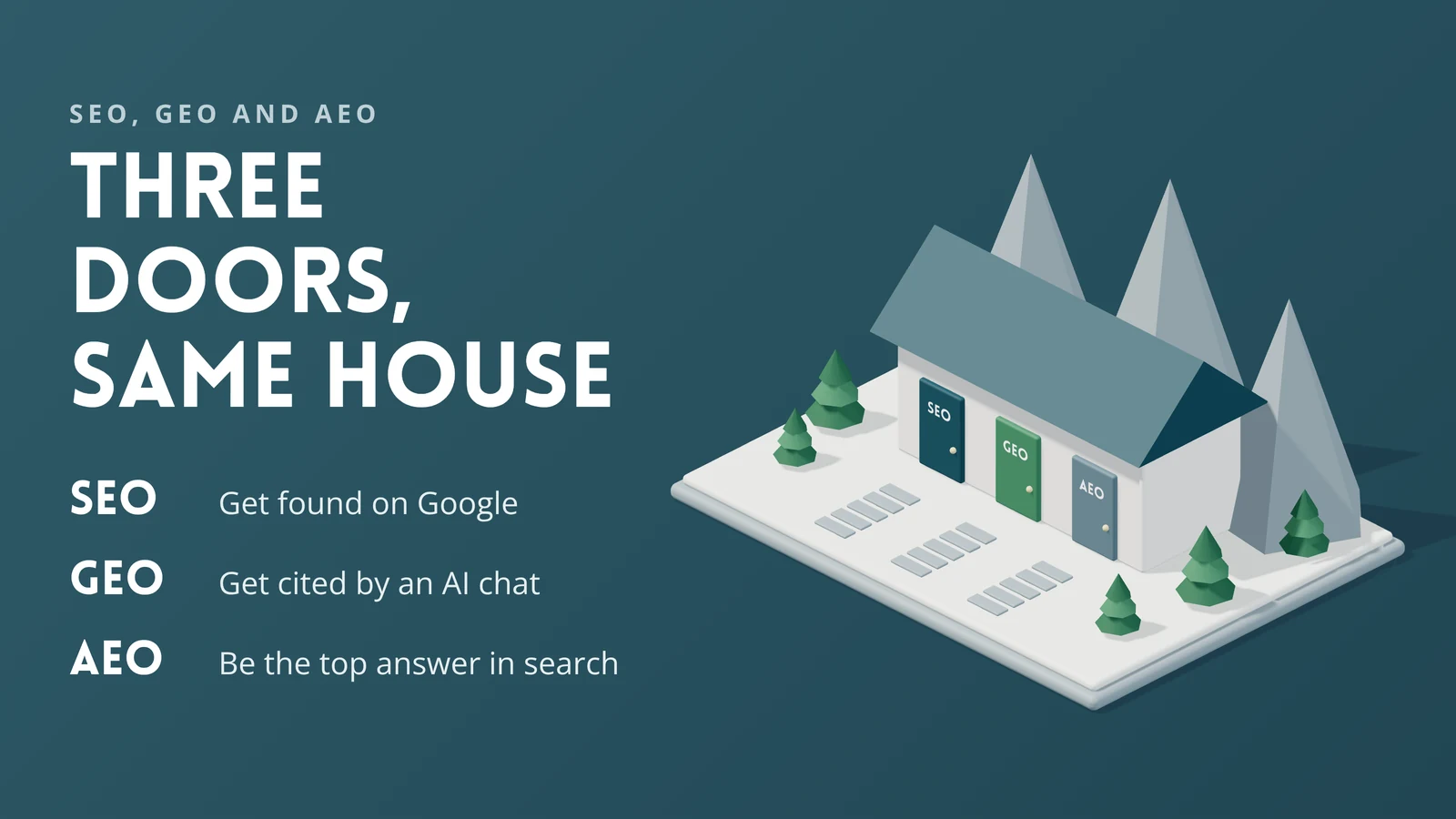
SEO is getting found on Google. GEO is getting mentioned or cited when someone asks an AI chat a question. AEO, or answer engine optimization, is getting your answer shown at the top of a search. The same well-built pages win at all three, which is why we treat them as one job.
That’s how Ignacio puts it when a business owner asks. His shorthand: three doors to the same house.
- Search engine optimization (SEO): helps Google find your pages, understand them and show them when customers search.
- Generative engine optimization (GEO): makes your content trustworthy and clear enough that an AI model chooses to quote or reference it.
- Answer engine optimization (AEO): shapes a page so Google can pull it out as the direct answer.
People ask about AEO vs GEO a lot because the two overlap. AEO goes after the answer box on a results page. GEO goes after the sources an AI names in a conversation. For the search-results side, here is how AEO compares to traditional SEO.
The 3 Biggest Differences Between SEO and GEO
SEO vs GEO comes apart in three places: what counts as a win, what gets rewarded, and what makes your content worth using. With SEO you fight for a spot on a results page and hope for the click. With GEO you need an AI to trust you enough to name you.
8% vs 15%
of visits clicked a regular result with an AI summary on the page vs without one
1. Rankings Versus Citations
“SEO is built around rankings,” Ignacio says. You compete for a spot on a results page or in a local listing, and traffic comes from people clicking through.
GEO doesn’t work like that. The AI reads your content, decides if it trusts it, then cites you or doesn’t. There’s no page two in an AI answer. You’re in the response or you’re not.
2. Keyword Targeting Versus Clear, Direct Answers
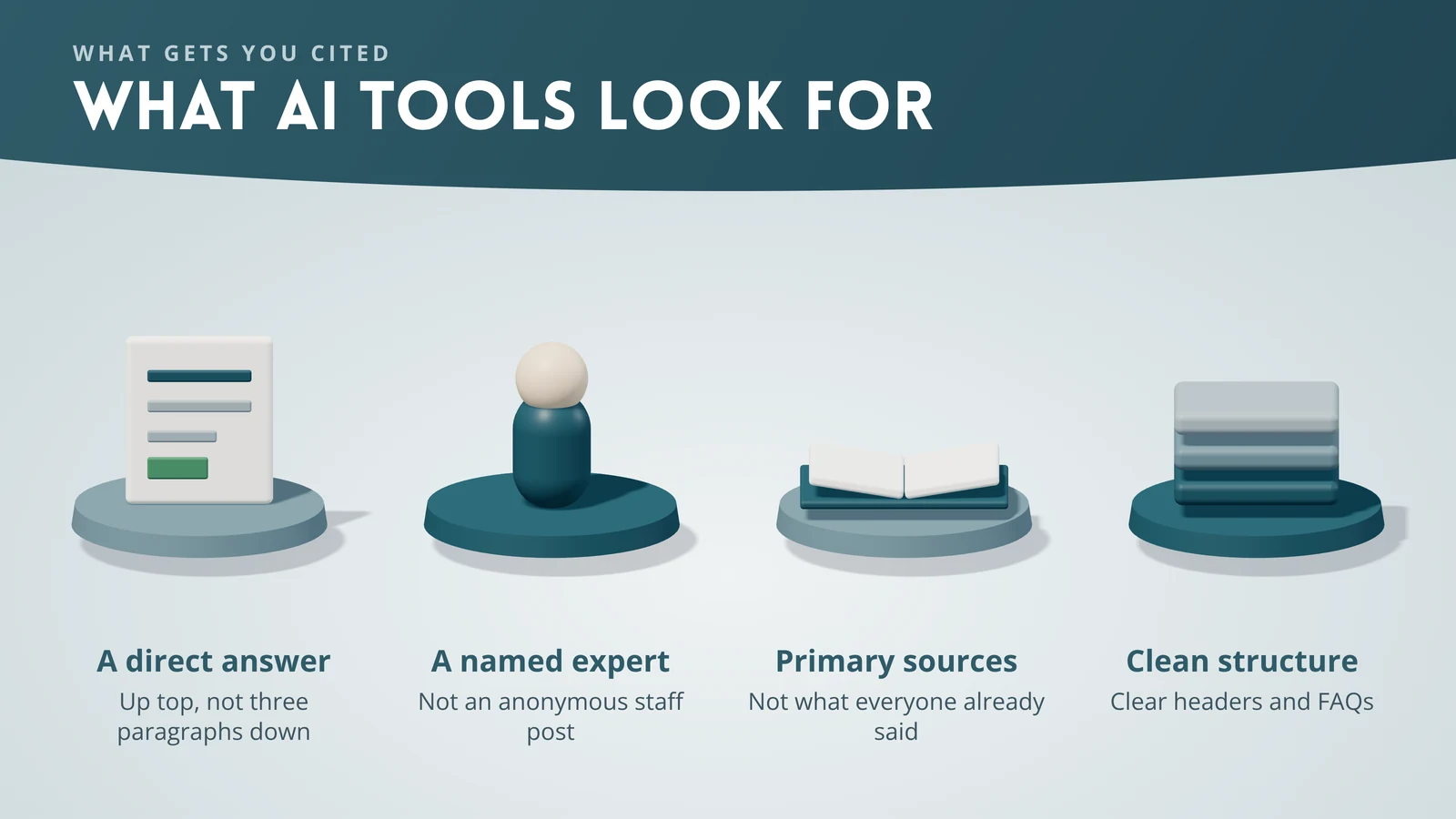
Classic SEO is keywords, a site Google can crawl, and links that earn authority. GEO asks a simpler question: can an AI find your answer fast and use it as written?
“SEO rewards keyword targeting and authority. GEO rewards clarity, direct answers, and content that’s clearly written by someone who actually knows the subject.”
Ignacio Lupsor, Head of Search
So when we are optimizing for ChatGPT and similar tools, we put the answer first. Headings use the questions people really ask. Nobody should have to read a long intro to get the point. Google’s own guidance on AI features and your website says the usual SEO best practices still apply to AI Overviews and AI Mode.
3. Authority Versus Original Expert Insight
Authority still counts for GEO. But why would an AI cite a page that repeats what fifty others already say? Ignacio calls the missing ingredient “original insight from the expert”: the details, opinions and examples that only someone doing the work can give.
The research that coined the term backs him up. The original GEO team tested what made content more visible in AI answers, and signals of real expertise came out on top:
Up to 40%
more visibility in generative engine responses when content adds citations, quotations and statistics
Here is how the two compare side by side:
| SEO | GEO | |
|---|---|---|
| The win | A ranking position and a click | A mention or citation in an AI answer |
| What it rewards | Keyword targeting and authority | Clarity, direct answers, real expertise |
| Where it shows up | Google results and local listings | ChatGPT, Gemini, Perplexity, AI Overviews |
| What it depends on | Indexing, relevance, links | Indexed, trusted content to pull from |
Can You Drop SEO and Just Do GEO?
No. Ignacio calls this one of the biggest misconceptions in search, and his answer is blunt: “GEO doesn’t work without SEO.” AI tools still pull most of their sources from content Google has already indexed and trusts. With a weak SEO foundation, there is nothing for an AI to find or cite.
“Think of SEO as the foundation, and GEO as what gets built on top of it, not a replacement for it.”
Ignacio Lupsor, Head of Search
Cutting your search engine optimization budget to pay for AI search optimization pulls the ground out from under the new work. Treat GEO as the next layer of AI SEO marketing and keep the basics strong:
- Make sure your key pages can be crawled and indexed.
- Answer the questions your customers actually ask, in the first lines of each section.
- Put a named expert behind the content and cite primary sources.
- Use clear titles, question-style headings, FAQs and internal links.
- Track rankings and AI visibility together, not in separate reports.
How SEO and GEO Feed Each Other: The Search Loop
SEO and GEO feed off each other, so Ignacio treats them as one practice: search marketing. Expert content gets cited by AI and builds domain authority. That authority lifts your rankings. Better rankings make AI tools more likely to cite you again. We call this the Search Loop.
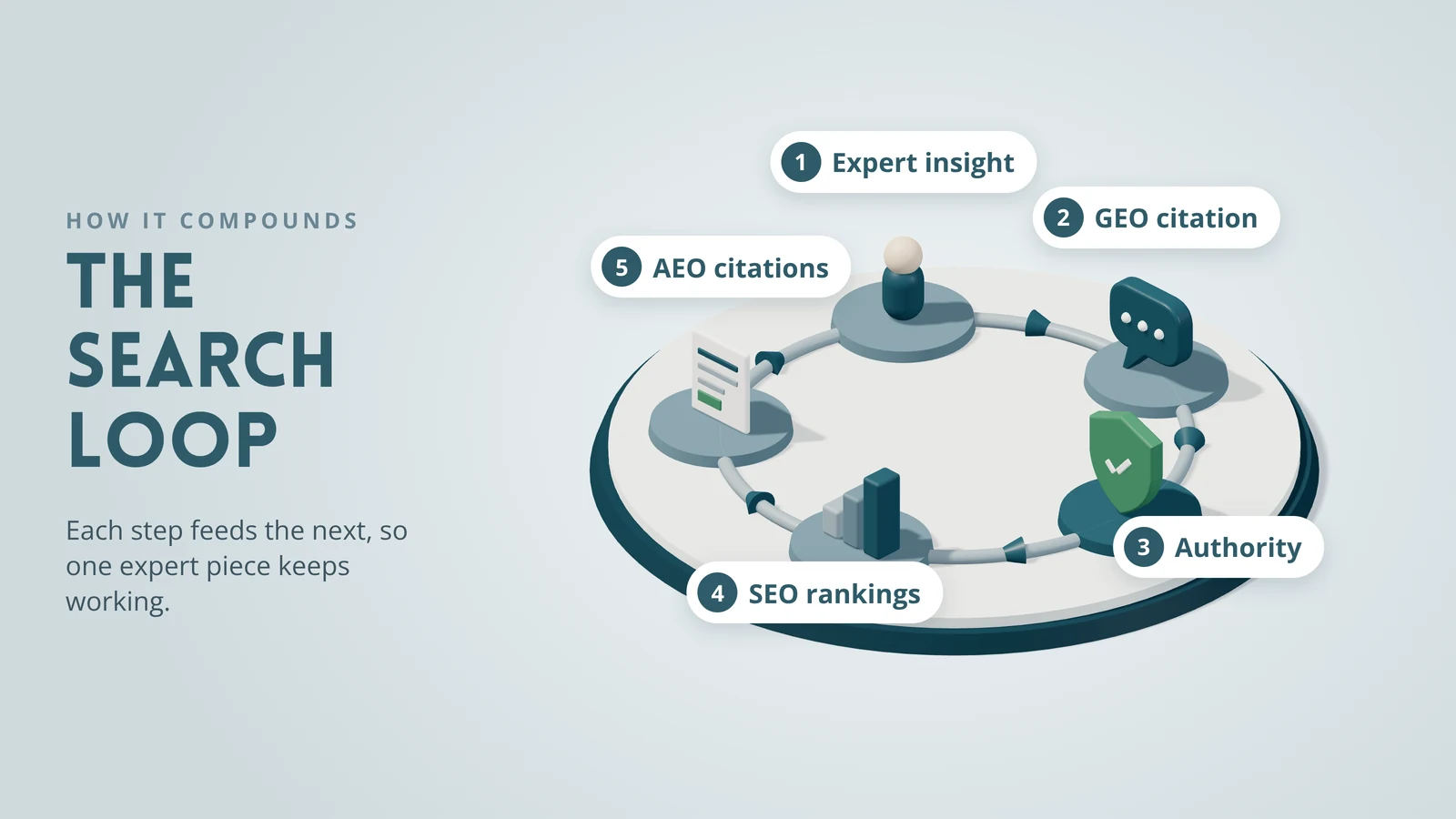
Here’s how it plays out:
- Expert insight: a real person answers a real customer question and says something nobody else has published.
- GEO citation: AI tools pick it up because it’s original and easy to pull.
- Authority: every citation gives search engines one more reason to trust your site.
- SEO rankings: you climb for the searches that bring in business.
- AEO citations: now you show up in AI Overviews and answer boxes, and the next interview starts it all over.
None of this works if step one is fake. Without an expert, the AI has nothing new to cite, and the loop stops there.
Not sure whether your site is ready for AI search? Our AI SEO services start by showing you where you rank on Google and where AI tools already cite you.
How The Brandsmen Handles SEO and GEO Together
As a Denver search marketing agency, we run SEO and GEO as one program. We sit down with the people who know your business and turn those talks into articles, video and social posts. Each page is built for Google and for AI tools, and your report shows rankings and AI visibility side by side.
Take Ignacio’s interview. One recorded conversation became this GEO vs SEO guide and the social posts around it. You bring the expertise. We handle the structure, schema and tracking.
If you want a search marketing agency that treats SEO, AEO and GEO as one strategy instead of three line items, that is the work we do every month.
Frequently Asked Questions
Is GEO replacing SEO?
No. GEO depends on SEO, because most AI tools pull from content search engines already index and trust. Drop SEO and you lose what those answers are built from. The two work best together, with GEO added on top of a strong SEO base.
Is GEO the same as AEO?
Not quite. In AEO vs GEO, AEO aims to make your content the direct answer on a search results page, such as a featured snippet or AI Overview. GEO aims to get your business cited inside conversational AI answers from tools like ChatGPT, Gemini and Perplexity. Both reward clear structure, direct answers and real expertise.
What does GEO stand for in marketing?
GEO stands for generative engine optimization. In plain terms, you shape your content so tools like ChatGPT, Gemini, Perplexity and Google’s AI features mention your business when they answer a question. The term comes from a research paper published at KDD 2024.
How do I start optimizing for GEO?
Fix your SEO first, so your key pages are indexed and work properly. Then rewrite those pages so each section opens with the answer. Put a named expert on them, cite primary sources and use real questions as headings. After that, check where AI tools mention you and keep publishing original expert content.

Alex Vere Nicoll
Co-Founder, The Brandsmen
Alex co-founded The Brandsmen in 2014 after several years in marketing and branding roles, and he leads the conversations behind our expert interviews.
In conversation with
Ignacio Lupsor
Head of Search @ The Brandsmen
Ignacio builds the strategy and content systems that get our clients found on Google and cited by AI, with search programs running across industries, languages and markets.
Related Posts

What Is GEO? A Clear Guide to Generative Engine Optimization
A plain-language guide to generative engine optimization and how AI tools choose which brands to mention.
December 22, 2025

AEO vs SEO: What’s the Difference in 2026?
How answer engine optimization and traditional SEO differ, and where each one shows up in search.
January 22, 2026

AI SEO Agency: Why Your Business Needs SEO and AI Search in 2026
Why visibility in 2026 means showing up in both Google results and AI-generated answers.
May 27, 2026
About the Author